Understand Stitch Multiples Before Rounding a Cast-On
Read repeat formulas, account for edge stitches and check that a sizing adjustment still fits the stitch pattern.
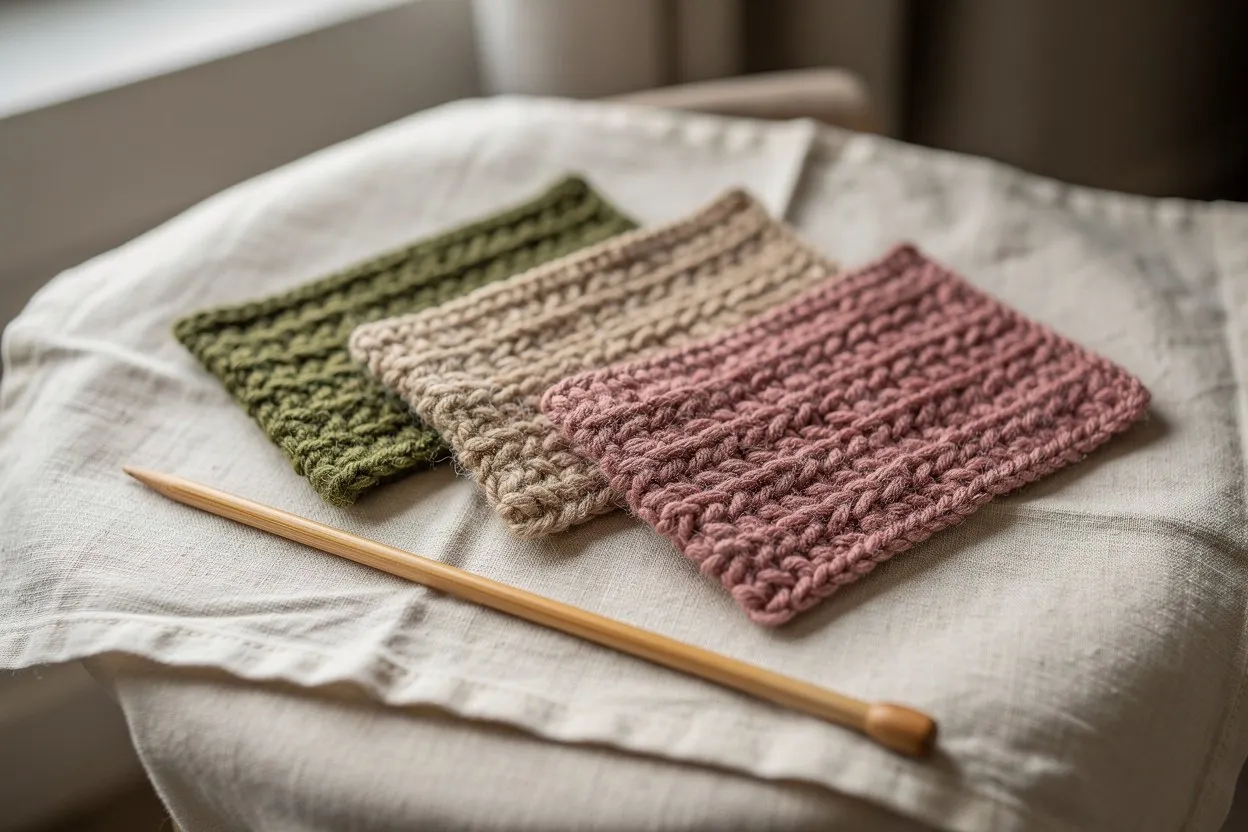
A stitch multiple tells you which stitch counts can support a repeating pattern. It is a structural rule, not a suggestion to round any number in whichever direction is convenient. When you resize a simple piece, calculate the approximate count from gauge first, then choose a count that respects the repeat and any edge instructions. Keep both steps in the notes so the result remains understandable.
Read the repeat as a formula
“Multiple of four” means counts such as 20, 24, 28 and 32 can contain complete groups of four. “Multiple of four plus two” means a total such as 22, 26, 30 or 34 when the two extra stitches are included in the stated formula. Those extra stitches may serve a particular edge or pattern function.
Read the surrounding instructions before adding more edges yourself. Some patterns include edge stitches in the formula; others describe them separately. Adding them twice can change both the width and the alignment of the stitch pattern.
Compare neighboring valid counts
Suppose your gauge calculation suggests 37 stitches, but the pattern requires a multiple of six plus two. Nearby valid totals are 32 and 38. A count of 37 does not become valid simply because it is close. Compare the implied widths and choose deliberately.
If your gauge is 20 stitches across 10 centimetres, 32 stitches represents about 16 centimetres and 38 represents about 19 centimetres before other effects. The difference may be too large for the intended project. In that case, changing the target, gauge or stitch pattern may be more sensible than forcing an unsuitable count.
Check the first and last instructions
Work through one row of the pattern on paper or in a small sample. Confirm where the repeating group begins and ends and what happens before and after it. A bracketed instruction may be repeated a specified number of times, while another convention may continue to a certain number of stitches before the end.
Use the pattern’s abbreviation key and conventions. Do not assume that similar punctuation has identical meaning in every source. If the count does not balance, pause and recheck the setup before casting on a large piece.
Record the adjustment with the project
The gauge calculator provides a basic size ratio; you still need to apply the pattern’s repeat. Save the approximate calculated count, the valid count you selected and the resulting estimated width. That explains the decision if you return to the work later.
For row repeats, use the row counter with a clear convention for completed rows and record the next instruction at stopping points. Before finishing, check whether the pattern requires ending on a particular row. A mathematically valid cast-on and a sensible stopping row help preserve the design, but neither replaces following shaping, edge and finishing instructions in the full pattern.